
Central Utility Plant (CUP) Upgrade and Modification Recommendation
Summary
Evaluate improvements for the Nelson-Atkins’ central utility plant to offer renewed equipment life, substatial energy efficiencies, and recalibrated carbon generation impacts toward a net-zero solution. The resultant evaluation revealed two options. One option offers good energy savings, a reduction in building carbon emissions, with well understood system components operating with current automation, at a standard capital investment cost. The other option offers significant energy savings, a net-zero carbon emissions target reduction, with well understood components operating with targeted automation addressing immediate needs, provided through increased initial investment offset by current federal funding opportunities.
BNIM and GDS recommend the Nelson-Atkins Museum of Art take advantage of their opportunity, invest in the prolonged future of the instatution, and invest in an option that achieves the greatest efficiencies, carbon reduction, and socialital impact. This option if featured as a component and example to the preservation of art would return this investment to the institution for decades. In doing so, the museum would further elevate their position as the cultrulal arts leader in Kansas City competing with the most prominate institutions around the world.
Benefit and Intent
Whenever building systems require replacement, any institution should review, evaluate, and consider betterments to standard replacement options. Owners should begin reviewing the existing systems nearing the end of its useful life. Whenever equipment and its replacement components are becoming no longer regularly serviceable, planned replacement should be scheduled. For any replacement, owners should utilize replacement capital to provide a holistic solution for the immediate and reasonable future. Solutions should meet the owner’s goals for operation, maintenance, reliability, efficiency, longevity, and social impact.
Current and Future Operational Goals
Museum leadership requested options presenting the greatest social impact, energy efficiency, and life cycle cost analysis across a 60 year timeline.
History
The existing CUP was designed and constructed around year 2000 prior to the opening of the Bloch Building. The design utilized steam heating, steam humificiation, and refrigeration cooling. The design pre-dated energy code requirements, computer simulated energy modeling alternatives, and social impact considerations. The installed equipment utilizes refrigerate is no longer allowed now costly to address by the repair industry. The operation pre-dated response automation for indoor and outdoor dynamics with machine learner functions.
Approach
Provide review of existing systems, performance, and operation. Develop several alternatives for initial consideration. Reduce the alternative number for energy modeling comparisons. Refine the options based on the owner’s goals. Provide a recommendation of the most impactful option(s).
Options Considered
- All CUP options considered highly efficiency water atomizing humidification.
- Refrigeration cooling equipment with hot water gas boilers.
- Air source heat pump with hot water gas boilers.
- High efficiency refrigeration cooling equipment with condensing hot water gas boilers.
- High efficiency refrigeration cooling equipment incorporating free cooling heat exchangers with condensing hot water gas boilers.
- High efficiency refrigeration cooling equipment incorporating free cooling heat exchangers with condensing hot water gas boilers supplemented with a heat recovery refrigerant chiller.
- High efficiency refrigeration cooling equipment incorporating free cooling heat exchangers with hot water electric boilers supplemented with a heat recovery chiller.
- Geothermal heat pumps and high efficiency refrigeration cooling equipment with electric boilers.
- Storage source ice thermal system using heat pumps and high efficiency heat recovery refrigerant chillers equipment with electric boilers.
- Geothermal heat pumps and high efficiency ice thermal storage electric utility peak-shave refrigeration cooling equipment with electric boilers.
Options Modeled For Energy and Carbon Emission Comparisons
- All CUP options considered highly efficiency water atomizing humidification.
- High efficiency refrigeration cooling equipment with condensing hot water gas boilers.
- High efficiency refrigeration cooling equipment incorporating free cooling heat exchangers with condensing hot water gas boilers.
- High efficiency refrigeration cooling equipment incorporating free cooling heat exchangers with condensing hot water gas boilers supplemented with a heat recovery refrigerant chiller.
- Storage source ice thermal system using heat pumps and high efficiency heat recovery refrigerant chillers equipment with electric boilers.
- Geothermal heat pumps and high efficiency ice thermal storage electric utility peak-shave refrigeration cooling equipment with electric boilers.
Leadership and Operation Concerns
The institution is challenged by ongoing changes to their mission and how it will be delivered which present concerns for each system. Accessibility, serviceability, reliability, and flexibility are all notable concerns. Ultimately an isolated concurrently maintainable utility plant that does not impede current and future Museum galleries, art, and public interaction was directed. Any conflict a system option might create was reviewed and considered negatively during consideration.
Results
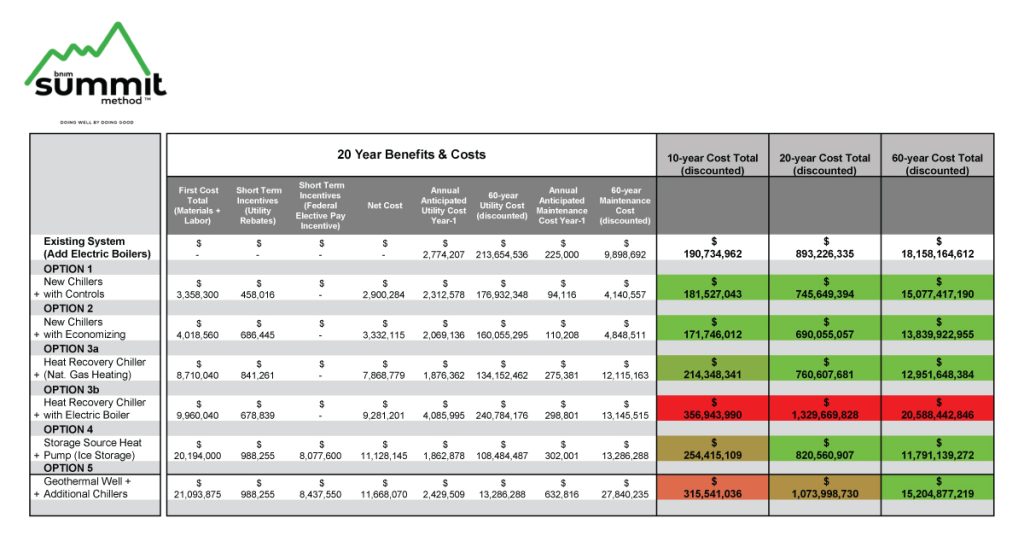
TABLE 1 – BNIM’s Summit Method Analysis comparing mutually exclusive options to each other in order to determine the best outcomes, both financial and non-financial
Conclusions
BNIM and GDS recommend the Nelson-Atkins Museum of Art take advantage of their opportunity, invest in the prolonged future of the instatution, and invest in an option that achieves the greatest efficiencies, carbon reduction, and socialital impact. This option if featured as a component and example to the preservation of art would return this investment to the institution for decades. In doing so, the museum would further elevate their position as the cultrulal arts leader in Kansas City competing with the most prominate institutions around the world.
Option four or five offer the greatest impact for the museum. Option five presents concerns for the future expansion of the Museum campus. Either present similar maintenance considerations.
Jeffrey Kling P.E., LEED AP, CPD
Vice President – Mechanical Engineer
Gibbens, Drake, & Scott, Inc.