
Improving comfort, reducing infiltration, and protecting the building’s collections.
The Library’s envelope review identified several areas where thermal performance and moisture control warrant attention. Roof conditions, curtain wall connections, and older masonry transitions are particularly relevant.
Sections:
Priorities included:
- Conducting thermal imaging and infiltration testing
- Examining roof system performance (including DuraLast and 50-year shingle zones)
- Verifying flashing and gutter transitions in older wings
- Reviewing window and glazing performance for heat gain/loss
- Creating an envelope maintenance plan with seasonal checks
A complete envelope dataset will help the Library better anticipate long-term maintenance costs, energy use impacts, and climate-driven risk.
Introduction
This section explores how envelope upgrades at two historic Kansas City institutions — the Nelson-Atkins Museum of Art and Linda Hall Library — can reduce climate risk, cut carbon emissions, and protect priceless collections for decades to come.
Purpose & Scope
The purpose of this report is to assess the building envelopes of the Nelson Atkins Museum of Art and the Linda Hall Library, focusing on mitigating climate risks, reducing carbon footprints, and enhancing environmental resiliency. The building envelope plays a crucial role in energy efficiency, preservation, and resiliency, especially within historic structures. By evaluating the current performance and identifying areas of improvement, this study seeks to develop data-driven strategies for optimizing the building envelopes’ efficiency and durability.
Funding for this project was provided, in part, by a grant via the National Endowment of the Humanities with the expressed reason to disseminate the findings of this effort so that they can be shared with many similar institutions.
Importance of the Building Envelope
The building envelope serves as the first line of defense against external environmental factors, including temperature fluctuations, humidity variations, and extreme weather events. Effective envelope performance directly impacts energy consumption, indoor environmental quality (IEQ), and the long-term preservation of building materials. In historic structures like the Linda Hall Library and the legacy Nelson Building at the Nelson Atkins Museum of Art, envelope improvements must also respect architectural integrity and preservation guidelines.
Contextual Background
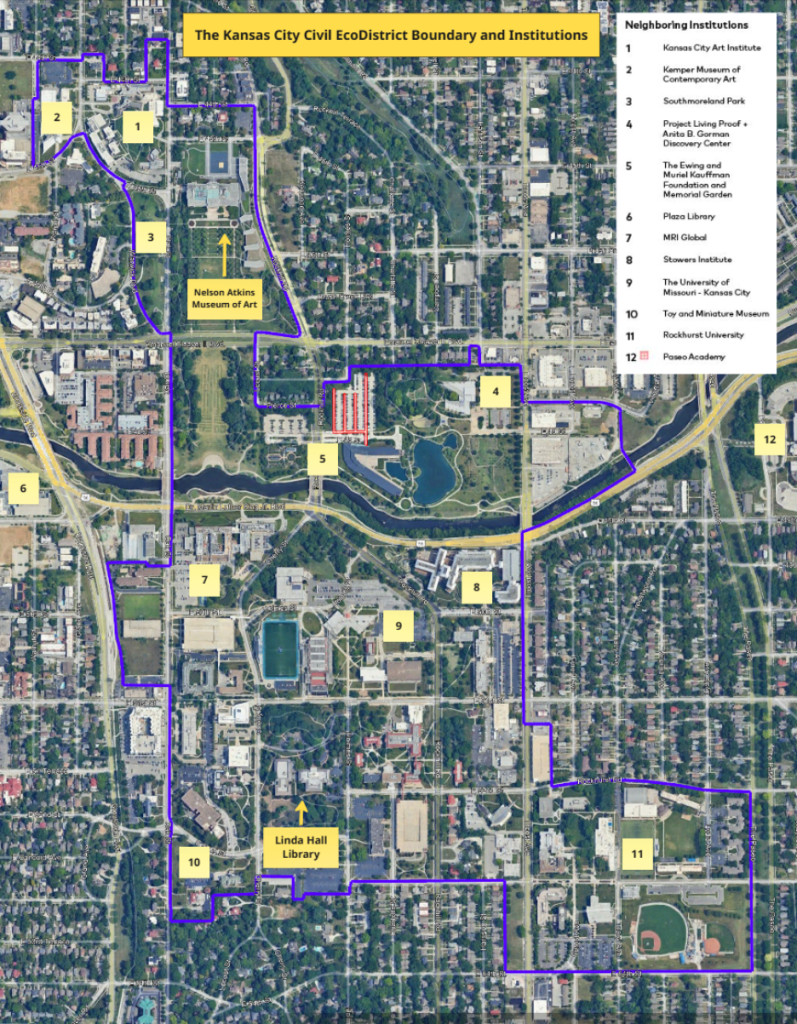
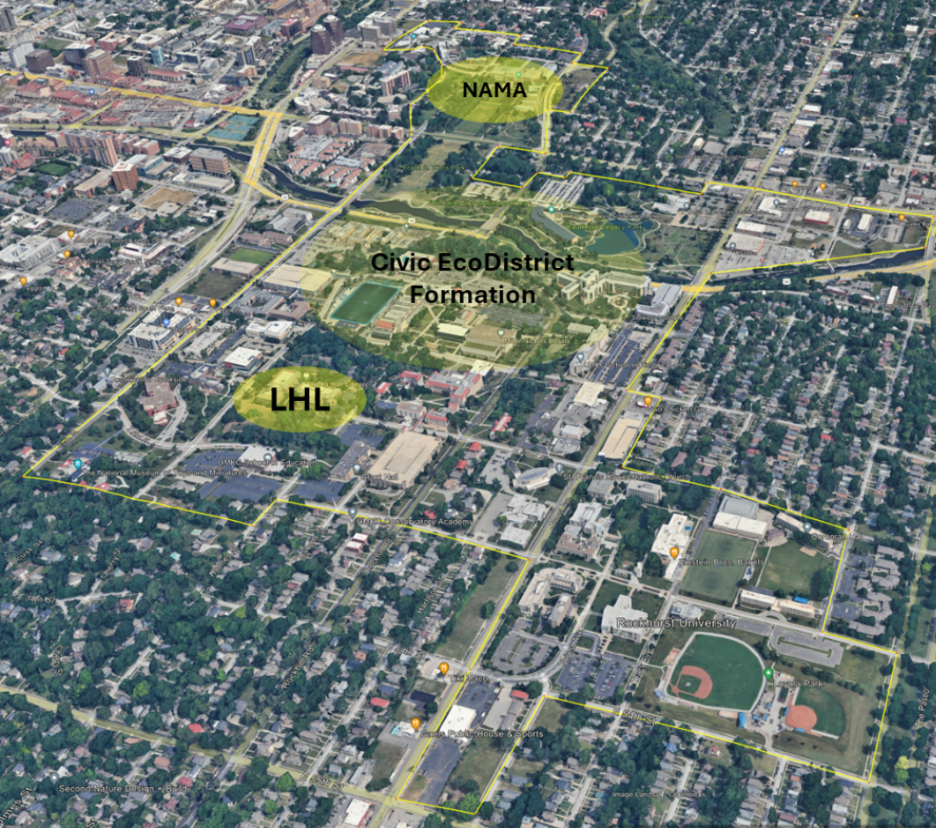
The Linda Hall Library and the Nelson Atkins Museum of Art are significant cultural institutions with deep historical roots in the Kansas City metropolitan area [See Figures 1 & 2]. Their preservation and sustainability are essential not only for their operational continuity but also for maintaining their cultural and architectural heritage. Previous studies have identified key climate risks, including temperature extremes, storm events, and humidity control challenges, that threaten the longevity and efficiency of these structures.
By assessing the existing building envelope and implementing targeted improvements, this project aims to safeguard these historic institutions from current and future environmental challenges while reducing operational carbon footprints and enhancing occupant health and wellbeing.
FIGURE 1 & 2 — Kansas City’s Civic EcoDistrict and Kansas City EcoDistrict Formation Bookended by Founding Institutions
Conclusions & Recommendations
Summary of Key Findings and High-Impact FIMs
Across the buildings evaluated, the envelope assessments and modeling reinforce a central conclusion: the most impactful envelope strategy — by a wide margin — is reducing uncontrolled air leakage through improved airtightness and better detailing at transitions and penetrations. This measure consistently delivers large energy benefits while also improving comfort, reducing moisture risk, and strengthening resilience during extreme weather events.
Other measures tended to cluster as “incremental energy gains but meaningful co-benefits,” including:
- Glazing strategies that reduce overheating and glare, improve comfort near windows, and support stable interior conditions for collections.
- Roof insulation upgrades that are most effective when bundled with planned reroofing cycles.
- Selective foundation-edge insulation and drainage improvements that reduce localized moisture issues and improve perimeter comfort, even when annual energy savings are modest.
- Water management and moisture control as a core resilience strategy — particularly important for long-term durability and artifact protection.
In short: tightness and transition detailing first; glazing and roof upgrades next (timed to capital cycles); deeper retrofits as part of long-range planning.
Long-Term Vision for Climate Adaptation and Carbon Neutrality
The long-term opportunity is not only to reduce energy use, but to strengthen each institution’s ability to preserve culture and knowledge under changing climate conditions. The envelope plays a foundational role in that vision by:
- Reducing exposure to extreme temperatures, wind-driven rain, and humidity swings
- Improving the stability of perimeter zones where discomfort and condensation risks concentrate
- Supporting operational resilience during outages by slowing temperature and humidity drift
- Enabling right-sized and lower-carbon mechanical solutions by reducing heating/cooling loads
Over time, a high-performing envelope becomes a platform for broader decarbonization: as load decreases, electrification and high-efficiency central plant strategies become more effective and less costly. The result is a credible pathway to substantially lower operational emissions while improving the visitor and staff experience and strengthening collection stewardship.
Next Steps for Execution, Funding, and Policy Alignment
To move from planning to implementation, the recommended next steps are:
- Confirm priorities with a short-list of “Tier 1” FIMs
Select a near-term package centered on airtightness, water management, and the highest-risk interfaces. Define measurable success criteria (energy, comfort, moisture risk reduction). - Develop a building-by-building implementation package
For each building, define scope boundaries, preservation constraints, constructability considerations, and the recommended timing relative to capital cycles (roof, façade, site work). - Create a funding strategy tied to the implementation schedule
Build a simple funding matrix linking each priority FIM to potential incentives, grants, and internal capital timing. Identify documentation needs early (baseline utility data, condition assessments, scope narratives). - Adopt an M&V plan as a standard practice
Establish ongoing tracking for utilities, targeted envelope testing, and perimeter IEQ metrics so outcomes are visible and improvements can be fine-tuned. - Align internal standards and policies
Update design and maintenance standards to preserve gains over time: airtightness details at penetrations, sealant standards, roof drainage inspection routines, glazing performance targets, and stormwater management practices.
Is this scalable for other institutions?
Yes!
While this study was conducted for the Nelson-Atkins Museum of Art and Linda Hall Library, the methodology, performance metrics, and implementation strategies are intentionally designed to be transferable to other cultural, academic, and institutional buildings — including those with limited budgets, historic constraints, or phased capital planning.
In summary, this methodology works for these core reasons:
- Focused on building types, not just names
- A tiered, phased improvement framework
- Performance metrics that translate across campuses
TABLE 1 — Pragmatic Roadmap of Improvement Priorities
| Institution Type | How to Apply This Study |
| Small museums or libraries | Focus on airtightness, roof drainage, and targeted glazing improvements to reduce risk and operating costs quickly |
| Universities and multi-building campuses | Use the framework to triage buildings by envelope type and prioritize limited capital funds |
| Historic institutions | Apply preservation-compatible strategies (interior insulation, secondary glazing, vapor-open assemblies) |
| Newer facilities | Use findings to inform commissioning, maintenance standards, and future retrofit planning |
| Nonprofits with grant funding | Leverage the phased roadmap to align scopes with grant cycles and reporting requirements |
This roadmap supports immediate, practical action while building toward a longer-term resilience and carbon-reduction strategy — one that is scalable across campus partners and repeatable for peer institutions