
Understanding how soils, stormwater, plants, and microclimates support long-term resilience.
The Library’s grounds provide opportunities for improved stormwater management, greywater reuse, and ecological enhancement. Discussions explored links between the detention pond, irrigation needs, and infiltration challenges.
Sections:
- Introduction
- Assessment Framework for Landscape Systems
- Current Landscape Performance (Summary)
- Diagnostic Landscape Findings
- Climate Risk & Environmental Footprint (Landscape Edition)
- Carbon & Energy Impact Analysis (Landscape Version)
- Facility Improvement Measures (FIMs) — Landscape
- Implementation Strategy & Roadmap
- Conclusions & Recommendations
Recommended Next Steps:
- Evaluate potential for reusing detention pond stormwater for irrigation
- Map microclimates and tree canopies to reduce heat exposure
- Implement soil testing to track changes in moisture, compaction, and infiltration
- Explore native planting zones aligned with the district ecosystem
- Identify opportunities for on-site stormwater pre-treatment and filtering
These actions prepare the Library for future climate shifts, while supporting a healthier campus environment.
Introduction
Purpose & Scope
The landscape systems for the Linda Hall Library (LHL) and the Nelson-Atkins Museum of Art (NAMA) play a crucial role in climate readiness, environmental resilience, and long-term preservation of both buildings and grounds. This Landscape Lens establishes a repeatable framework for evaluating landscape performance across institutional campuses, focusing on hydrology, carbon sequestration, thermal comfort, stormwater performance, material cycles, and biodiversity.
Because the NEH grant required all work to remain pre-decisional, this section does not propose final designs. Instead, it defines the yardstick by which landscape systems can be evaluated and improved over time.
Importance of the Landscape System
Landscape systems influence nearly every dimension of institutional resilience:
- Hydrology & stormwater management – protection of foundations, drainage paths, soil stability
- Microclimate modification – cooling, shading, wind mitigation, humidity buffering
- Carbon sequestration & ecological function
- Visitor experience & public engagement
- Long-term preservation of historic structures
The landscape systems are interdependent with the building envelope, mechanical systems, and utilities. Landscape failures often manifest as basement moisture, foundation settlement, increased HVAC loads, or envelope deterioration, making this lens essential to institutional climate strategy.
Contextual Background
Linda Hall sit within a mature urban landscape with expansive lawns, tree canopies, paved paths, and formal gardens. Historic design intent, operational constraints, aging irrigation systems, and Kansas City’s evolving climate have created a set of shared risks:
- More intense rainfall and more frequent drought
- Increased freeze–thaw cycles
- Urban heat island intensification
- Soil desiccation and rehydration cycles causing foundation movement
- Loss of carbon-sequestering tree canopy from age, disease, or storm events
This Landscape Lens aims to equip institutions with a method to evaluate landscape health and identify improvements that support both building preservation and climate resilience.
Assessment Framework for Landscape Systems
Key Performance Indicators (KPIs) – Plain Language
| KPI Category | Plain-Language Description |
| 1. Stormwater & Hydrologic Performance | How well the site drains, absorbs, slows, filters, and stores water; ability to protect foundations and prevent erosion. |
| 2. Soil Health & Root Zone Stability | Quality and structure of soils; ability to support trees and prevent settlement. |
| 3. Vegetation Health & Carbon Sequestration | Tree canopy health, biodiversity, carbon sequestration, and long-term ecological function. |
| 4. Microclimate & Thermal Comfort | Shade, wind control, humidity buffering, UHI mitigation, and impact on building HVAC loads. |
| 5. Hardscape & Circulation Systems | Durability, permeability, heat absorption, and ADA functionality. |
| 6. Irrigation & Water Use Efficiency | Effectiveness, leaks, seasonal operations, drought resilience. |
| 7. Material Lifespan, Risk, & Replacements | Durability of landscape elements, expected service life, and maintenance burden. |
Technical KPI Matrix – For Design, Construction, and Operations Professionals
| Technical KPI Category | What Is Evaluated |
| 1. Hydrology & Drainage | • Infiltration capacity and percolation rates • Surface vs. subsurface drainage paths • Foundation-adjacent grading and moisture risk zones • Stormwater volumes for 2-yr, 10-yr, and 100-yr events • Soil saturation patterns and erosion indicators • Reliance on sump pumps or mechanical dewatering |
| 2. Soil & Root Zone Health | • Soil compaction, organic content, and structure • Moisture variability across seasons • Depth and stability of root zones • Soil settlement or voids near foundations • Nutrient profiles and topsoil depth • Impact of irrigation overspray or drought cycles |
| 3. Vegetation Health & Carbon Function | • Species diversity and age distribution • Tree canopy coverage (GIS-based) • Plant stress indicators (leaf scorch, dieback, pest activity) • Annual and lifetime carbon sequestration values • Vulnerability to storms, drought, disease, and heat • Reserve planting capacity for canopy succession |
| 4. Microclimate & Thermal Behavior | • Temperature differentials of pavements, lawns, and shaded zones • Wind exposure or buffering patterns • Seasonal shading diagrams near building envelopes • Humidity buffering from vegetation • Local heat island intensity • Impacts on perimeter HVAC loads |
| 5. Hardscape & Circulation Systems | • Pavement reflectance and heat absorption • Permeability and stormwater infiltration • Trip hazards, ADA compliance, and settlement • Freeze–thaw damage patterns • Stormwater shedding patterns • Longevity and maintenance requirements |
| 6. Irrigation & Water Efficiency | • Leak detection and pressure irregularities • Irrigation zoning and alignment with plant needs • Overspray and runoff onto pavements or buildings • Water consumption compared to baseline plant demand • Seasonal programming effectiveness • Integration with soil moisture sensors |
| 7. Asset Condition & Lifespan | • Expected service life of trees, pavements, retaining walls, site furniture • Material deterioration (rot, rust, cracking) • Vulnerability to cli mate-intensified exposure • Documented maintenance cycles and staffing requirements • Cost implications of deferred landscape maintenance |
Current Landscape Performance (Summary)
- Exceptional arboretum-quality tree canopy, a major carbon sink.
- Several areas with foundation-adjacent drainage failures → contributing to observed settlement on the north façade (confirmed in envelope section).
- Mixture of formal plantings and lawns; many lawns provide low ecosystem value compared to canopy.
- Some hardscapes and paths hold heat and accelerate thermal loading.
- Irrigation systems older and lacking smart controls → vulnerable to overwatering and drought stress cycles.
Diagnostic Landscape Findings
While envelope diagnostics used thermography, landscape diagnostics rely on:
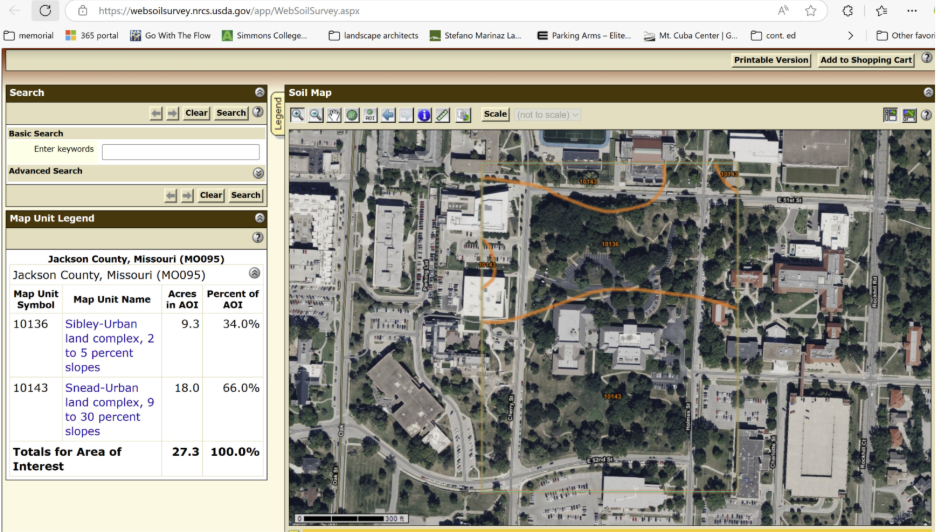
- Soil moisture mapping
- Ground-penetrating radar near settlement zones
- Hydrologic modeling
- Tree canopy Geographic Information System (GIS) analysis
- Infiltration and percolation testing
- Drone-based grading & drainage mapping
- Pavement temperature and reflectance scans
Common Findings
- Drainage failures and foundation adjacency risks
- Long-term soil compaction reducing infiltration
- Aging trees requiring phased replacement
- Excess turf areas providing minimal ecological function
- Hardscape areas contributing to Urban Heat Island Effect (UHI)
- Lack of bioswales, rain gardens, or decentralized stormwater control
- Irrigation inefficiencies causing mixed wet/dry cycles
Climate Risk & Environmental Footprint (Landscape Edition)
Landscape Climate Adaptation Matrix
| Climate Factor | Risks | Applicable Building / Landscape Areas | Effective Mitigations |
| Increased Heavy Rainfall | Foundation movement, erosion, ponding, root rot | LHL north façade, Nelson south lawn, perimeter grades | Bioswales, French drains, grade correction, soil rebuilding |
| More Severe Droughts | Tree loss, soil shrinkage, foundation settlement | All campuses | Smart irrigation, drought-tolerant understories, deep-rooted plantings |
| Heat Waves / UHI | Increased HVAC loads, visitor discomfort | Bloch entry plazas, Nelson lawns | Shade expansion, canopy succession planting, reflective pavements |
| Freeze–Thaw Cycles | Pavement heave, root damage | All pavements | Permeable pavements, improved subbase, reduced irrigation overspray |
| Storm Intensity | Windthrow of trees, erosion, damage to sculptures | Exposed slopes, major canopy zones | Wind-firm species, root ball anchoring, soil stabilization |
Carbon & Energy Impact Analysis (Landscape Version)
Carbon Sources & Sinks
- Tree canopy = major long-term carbon sink (LHL especially)
- Lawns = carbon neutral to carbon negative due to mowing, fertilizer, irrigation
- Pavements = embodied carbon + thermal storage contributing to operational emissions
- Green roofs (Bloch) = modest carbon sink, strong microclimate benefit
Operational Energy Cross-Impacts
Landscape choices influence:
- Perimeter cooling loads
- Envelope drying potential
- Moisture loads at foundations
- HVAC runtime due to shading or heat exposure
Embodied Carbon in Landscape Interventions
- Hardscape replacements
- Soil importation
- Tree planting (low impact, high benefit)
- Green infrastructure (moderate impact, long-term carbon advantage)
Facility Improvement Measures (FIMs) — Landscape
Hydrology & Moisture Control
- French drains at critical perimeters
- Bioswales at downspout discharge points
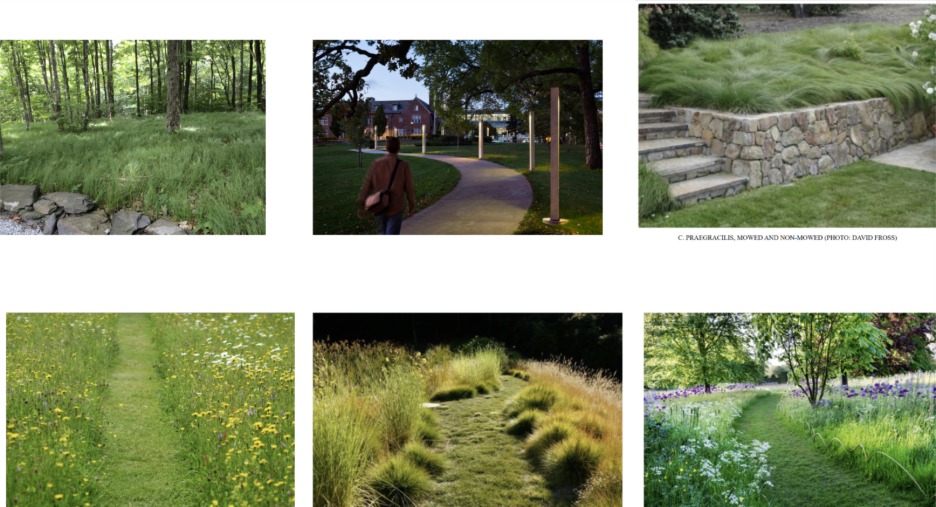
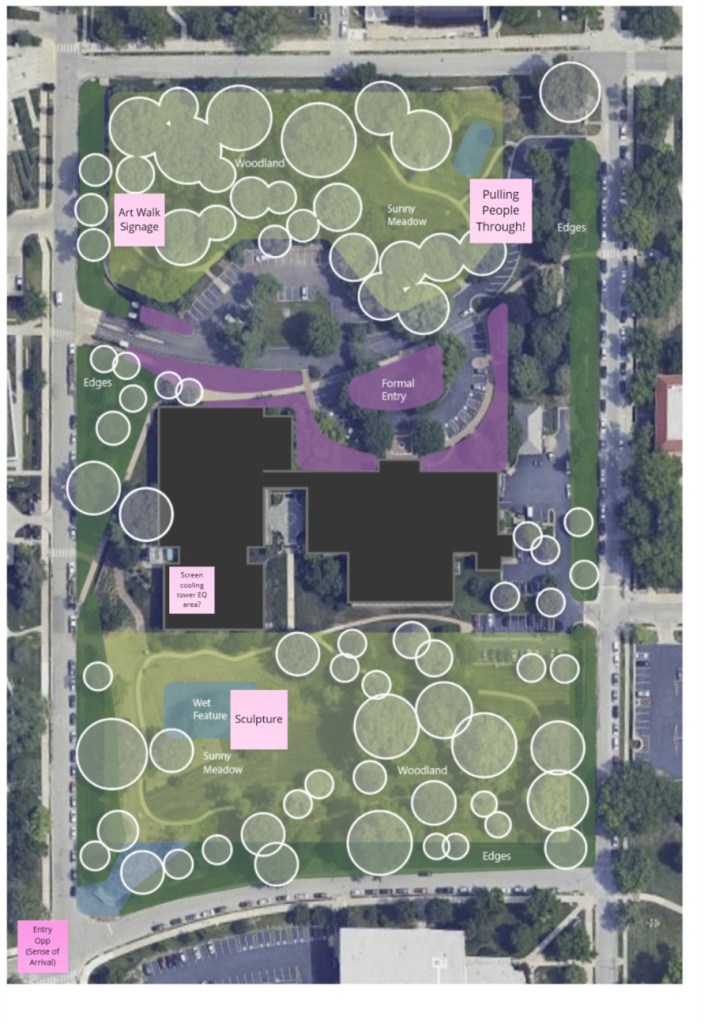
- Conversion of compacted lawn zones into meadow systems
- Green stormwater infrastructure (GSI) to reduce runoff
Soil Health & Stability
- Soil decompaction & compost amendment
- Structural soils near pavements
- Root zone aeration and biochar incorporation
- Targeted foundation moisture stabilization
Vegetation & Carbon
- Successor canopy planting plan (20–30 year horizon)
- Carbon-modeling tree inventory and replacement sequence
- Native understory expansion
- Reduction of turf areas → pollinator gardens, meadow zones
Microclimate Mitigation
- Strategic shade tree placement near envelope heat gain zones
- High-albedo pavements
- Permeable pavements in visitor paths
- Additional green roof zones where structural capacity allows
Irrigation Efficiency
- Smart irrigation controllers
- Zoned irrigation matching plant water needs
- Soil moisture sensors and shutoff systems
- Removal of irrigation from tree drip lines to prevent rot
Hardscape & Circulation
- Replace failing pavements with permeable systems
- Regrade ADA paths affected by settlement
- Reflective and low-heat-gain paving materials
Implementation Strategy & Roadmap
Phase 1 – Foundational Risk Mitigation
- Priority drainage and grading
- Immediate tree health interventions
- Settlement and erosion risk reduction
Phase 2 – Climate-Forward Enhancements
- Bioswales, meadows, infiltration systems
- Smart irrigation + soil remediation
- UHI mitigation through shade and materials
Phase 3 – Long-Term Ecological Transformation
- Successor canopy
- Expansion of green roofs
- High-performance permeable circulation systems
- District-scale ecological connectivity
Conclusions & Recommendations
High-Impact, Low-Regret Opportunities
- Drainage corrections at LHL north façade
- Canopy succession plan for both institutions
- Turf conversion to meadows and understory plantings
- Permeable pavements in high-heat areas
- Smart irrigation deployment across both campuses
Long-Term Vision
A Landscape System That:
- Reduces operational carbon
- Protects historic structures
- Improves drainage, soil health, and tree longevity
- Enhances visitor comfort and campus identity
- Serves as a repeatable model for cultural institutions nationally